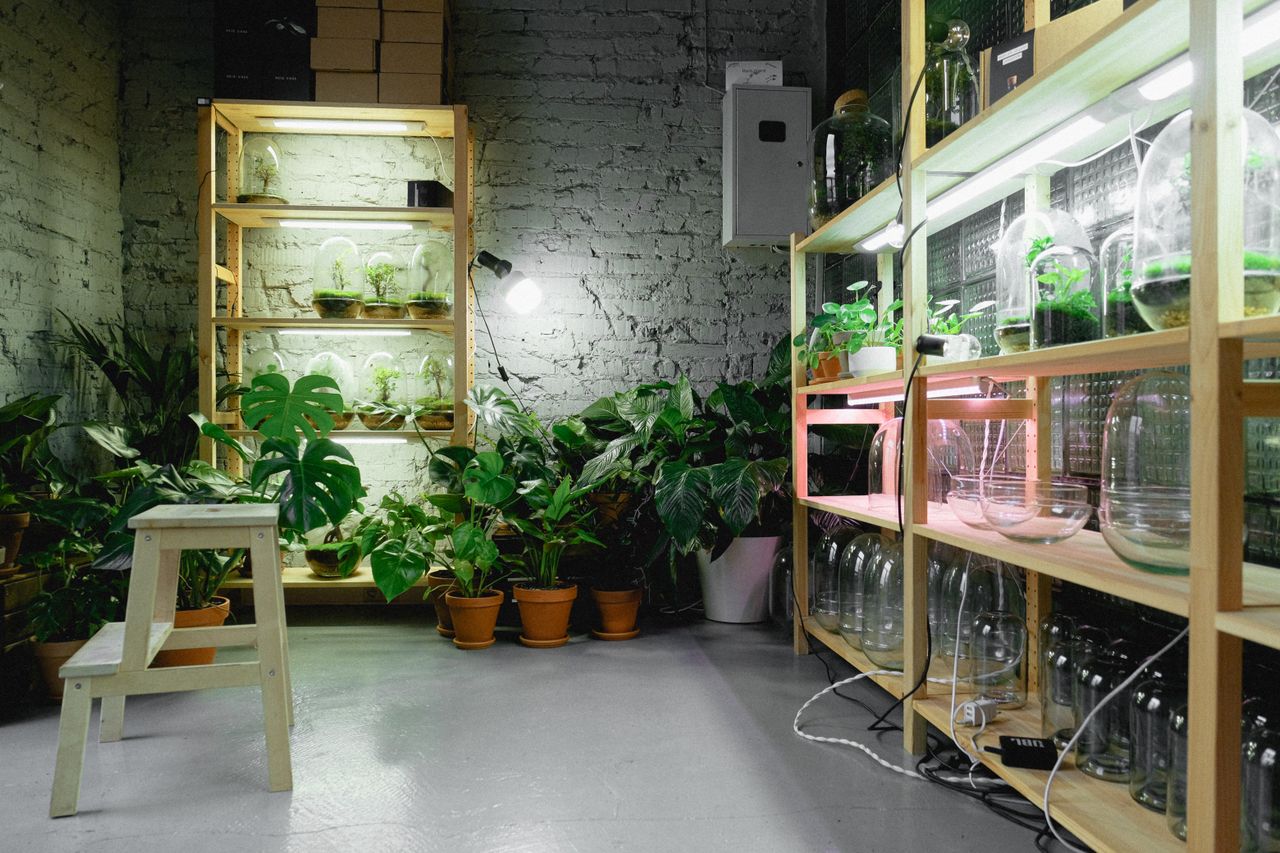
Want a thriving indoor garden that produces all year long? Water and nutrients will only get you so far. Without indoor grow lights, your plants will struggle to reach their full potential.
South-facing windows are a great start, but they don’t typically provide enough intensity or duration for vegetables or herbs. If you’ve been trying to grow plants indoors and noticed that your plants are “leggy,” this is why.
Grow lights solve the problem. And if you’re serious about having an edible indoor garden, then you’ll want to invest in a solid light setup for your plants.
Why?
Because grow lights help you enjoy:
- Year-round harvests
- Control over your garden’s growth cycles
- Predictable yields
- Flexibility in where you place your plants
Before we talk about setups, let’s make sure that you understand how grow lights work and why the color and intensity matter.
Skip this and go straight to our grow light setups section.
Why Color and Intensity Matter When Choosing Indoor Grow Lights
Like humans, plants have different needs throughout each stage of their lives. This is especially true when it comes to light.
Certain spectrums stimulate flowering. Others promote foliage growth. Intensity is also important, as is distance to the plant.
All of this information is important to know before you start growing so that you can set yourself up for success.
What Light Spectrums Affect Plant Growth?
Let’s start with spectrums, which are typically measured in nanometers, or nm.
Blue Spectrum Light and Plants (400-500 nm)
Blue spectrum light helps increase plant quality. It promotes strong stems, vegetative growth and dense foliage, which is great for herbs and greens.
It works by encouraging stomatal opening, allowing more CO2 to enter the leaves. It also drives peak chlorophyll pigment absorption for photosynthesis.
This spectrum is essential for seedlings and young plants during their vegetative states because it helps establish healthy root and stem structures.
Green Spectrum Light (500-600 nm)
Green light is considered the least efficient wavelength for photosynthesis, but it still plays a part in plant growth.
Plants reflect more green than any other visible spectrum, but it’s still absorbed and transmitted lower down the plant.
The jury is still out on how important green light is for indoor plants, but it certainly can’t hurt growth and is often preferred to bring some balance to indoor setups.
Red Spectrum Light and Plants (600-700 nm)
Red light is considered the most effective spectrum for photosynthesis. It’s highly absorbed by chlorophyll pigments, so it encourages stem, leaf and vegetative growth.
Most importantly, it helps stimulate flowering, fruiting and root development, which is critical for growing crops like peppers, tomatoes and herbs.
What Light Spectrum is Best for Growing Plants Indoors?
If you want to grow herbs and vegetables indoors, a full-spectrum light that covers 400-700 nm is ideal.
But spectrum isn’t the only thing to consider. We also need to think about light intensity.
Light Intensity and Distance
When it comes to light intensity, there are a few things to consider: PAR, PPF and PPFD.
What is PAR (Photosynthetic Active Radiation)?
PAR describes the wavelengths of light in the visible range of 400-700nm. In other words, it’s the light needed for photosynthesis.
PAR doesn’t actually measure light or intensity. Rather, it’s a measurement that helps growers determine the type and volume of light needed to optimize plant yields and health.
PPF (Photosynthetic Photon Flux)
PPF defines the measurement of PAR, and its value determines how much PAR is produced by any one lighting system per second.
PPF helps establish how much light from your grow lighting system can actually be used by your plants for photosynthesis.
PPFD (Photosynthetic Photon Flux Density)
PPFD measures PPF and the surface area. It establishes how many PAR photons land on a specific area.
Primarily, PPFD tells you how many essential photosynthetic photons are impacting the grow area.
When you purchase a grow light system, check the PPFD coverage map at different hanging distances. This will help ensure your plant canopy gets the right photon density for the specific plant you’re trying to grow.
What About Watts and Lumens?
When it comes to growing plants indoors, watts and lumens aren’t quite as important for the actual growth. But they shouldn’t be ignored. Here’s what you need to know:
Watts measure electrical power, not how much light is emitted.
Higher wattage means a higher electric bill, but it also means higher thermal output and greater ventilation needs. In other words, high-watt bulbs burn hotter, which means your plants will need more space.
Watts alone won’t tell you how much usable light your plants get. A higher wattage, older fixture may deliver less PAR than a modern, efficient LED bar light.
That said, watts can be useful when calculated alongside PAR to determine efficiency, or PPE (Photosynthetic Photon Efficacy).
Lumens measure visible light emitted.
While important, lumens can also be misleading. A fixture that’s heavy in green or yellow light will have a higher lumen output because it looks brighter to the human eye. But it lacks the high-density red and blue photons that plants need for optimal growth.
What Types of Indoor Grow Lights Are There?
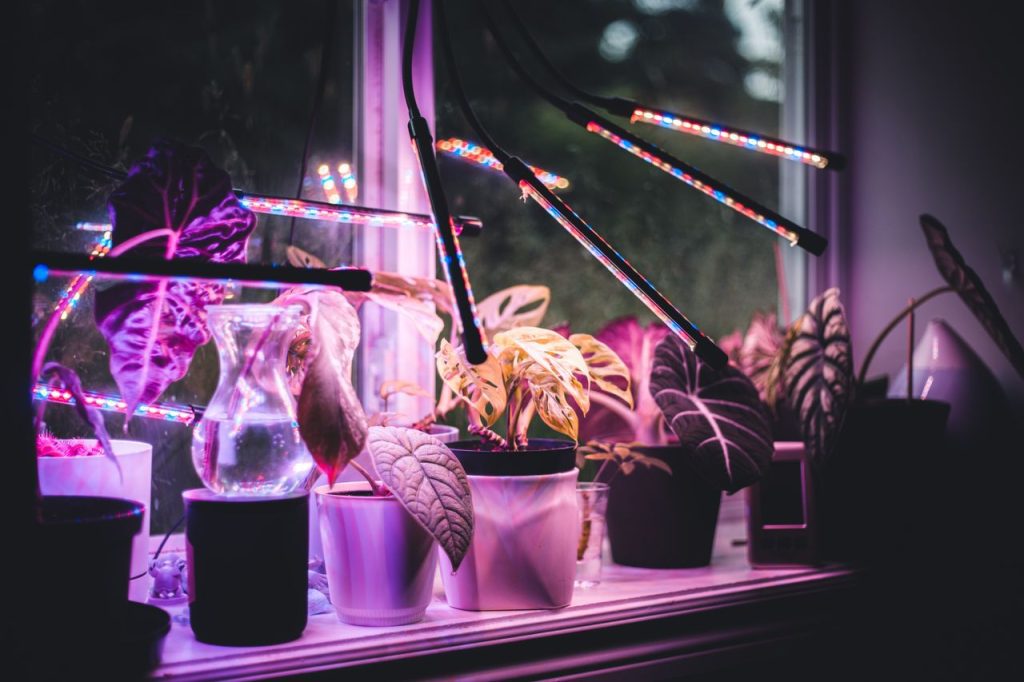
Now that you understand spectrums, intensity, wattage and lumens, you can consider what type of grow light you may want to invest in.
Here’s a quick overview of your options.
| Light Type | Energy Efficiency | Heat Output | Best Used For | Lifespan |
| LED Panels & Strips | High | Low to Moderate | All stages (herbs, greens, fruiting crops) | 50,000+ hrs |
| T5 Fluorescent Tubes | Moderate | Moderate | Seed starting, microgreens, leafy greens | 10,000–20,000 hrs |
| Screw-In LED Bulbs (E26) | High | Low | Single-plant desktop setups, clip-on lamps | 25,000+ hrs |
| HID / HPS / MH | Low | High | Large grow tents/commercial (rarely needed for herbs) | 10,000 hrs |
Step-by-Step DIY Setups
We’ve talked about all of the technical details and what types of lights are available for indoor growers. Now, let’s get into the nitty-gritty details of setting up your lighting system.
First, there are two things you need to consider: airflow and electrical safety.
Airflow and Microclimate Rules
You could have the best lighting setup in the world, but if you don’t have proper airflow, your plants will struggle.
Ultimately, you’re trying to recreate the outdoors inside, and air movement is constant outdoors.
Without proper airflow, your plants will consume available CO2 within minutes, which stalls photosynthesis.
Here’s how to ensure proper airflow:
- Maintain continuous and gentle leaf movement across all canopy tiers using clip-on fans. Gentle is the key word here. If the airflow is too strong, it can damage seedlings by causing windburn and desiccation. I really like this clip-on fan from Hurricane because the manufacturer has a bunch of options to choose from and two speeds.
- If you want to get technical, you can use this Air Exchange Formula (Enclosed Spaces):
- TargetCFM=VolumeofEnclosure(cu.ft.)1.5(Airexchanges/min)1.2(Ductresistancefactor)
Electrical Safety Rules
Standard residential electrical circuits (120V / 15A) are rated for continuous loads up to 1,440 Watts.
Make sure all of your grow lights, fans, and pumps on a single circuit breaker stay below this threshold.
Growing plants indoors is fun, but you want to be safe, so double-check this before you get everything set up and turned on.
A few other safety tips:
- Always connect equipment to a GFCI outlet or GFCI-equipped surge protector to prevent shock hazard if you have an accidental water spill.
- Don’t allow power strips, timers or drivers to sit on the floor where water could pool during irrigation. Mount all electronics on vertical frame posts at least 12 inches above the highest water reservoir.
Now, on to the good stuff!
The Countertop Setup (1-2 Plants)
If you only want to grow 1-2 plants, the countertop setup is simple and gets the job done. You don’t need any fancy plant racks or expensive hanging lights.
Here’s what you need:
Clip-on full-spectrum grow light bulb
A simple clip-on grow light is perfect for this small setup. There are lots of options on Amazon, but I love these two lights:
- SANSI grow lights. These clip perfectly onto your pot and hover over your plants. They’re a great option for bushier plants that won’t grow too tall. They come in a pack of two, so you can give each plant just the right amount of light.
- GooingTop full-spectrum light. I’ve had the bigger version of this grow light for years, and it’s never failed me. If you plan to grow taller plants, the gooseneck feature will allow your stems and leaves to shoot up without being burned.
Both of these options are really affordable, too. But any clip-on grow light will work well, so choose the one that meets your needs and budget.
Timer
Timers are really important for any indoor grow light setup because you don’t want to overdo it. There is such a thing as too much light.
The good news is that most grow lights, even clip-ons, have built-in timers. Both of the lights I shared above have this feature built-in, so you don’t need to buy any additional equipment.
That said, if you do wind up buying a light that doesn’t have a timer, you can use an outlet timer. It will automatically turn off your lights after a set amount of time.
I’ve also had luck with smart plugs. Just plug in your lights to the smart plug, and set it to go off at a certain time of the day.
For this type of setup, you can easily keep your plants on a countertop or tabletop. Just make sure there’s enough airflow.
Wire-Rack Farms with T5 or LED Strip Fixtures
For larger indoor growing setups, wire shelving is a great option.
You can find shelves designed for plants, but any unit that has a decent amount of space between each shelf should work well.
Amazon Basics has a five-shelf and a four-shelf option, and all of the shelving is adjustable. I recommend going with something like this because you can tweak your distance based on the types of plants you’re growing at the time.
Once you’ve chosen your shelving setup, you can find a T5 that works for you. The 2-foot Barrina light works well if you have wider shelves. It comes with 8 light strips and everything you need to hang the light from the bottoms of your shelves.
For smaller shelves, there’s a 1-foot option from Barrina. These come in a pack of four.
With a multi-tier setup like this, you can easily grow 6-12 plants, possibly more. Just make sure that you have enough light for all of your plants. Check the PPFD coverage map for this information.
Done-for-You Setups
I’m a big fan of DIY setups because they’re usually more cost-effective, but you can also find many done-for-you setups, such as:
- Nedechom plant shelf with grow lights. This four-shelf unit comes with three built-in, full-spectrum grow lights that have timers (9h,12h,15h). Each shelf can hold about 65 pounds, so you can easily grow veggies if you want.
- Barrina CX91 Plant Stand with Grow Light. This is a five-tier setup with adjustable shelf heights. You have a few different size and configuration options with this one. It even has a mechanical timer.
If you just want to get started and don’t want to be bogged down by too many details, one of these options may be a good fit for you.
Small Grow Tents or an Enclosed Space with High-Draw LEDs and Ventilation Fans
For serious indoor growers, a grow tent or a dedicated growing room will help you maximize your yields. Tents help keep plants warm and reflect light to really accelerate plant growth. As a bonus, you can close the tent “windows” to block the bright grow lights. That’s helpful if you don’t have a dedicated room for growing.
We have our setup in the dining room. Without a tent, we’d be blinded by our lights at night.
Now, there are many options in this category, and the prices can range from under $50 all the way up to $800+.
You’d be hard-pressed to find a grow tent setup that didn’t already have lights and ventilation built in.
Here are a few options in different price ranges:
Bstrip Small Greenhouse
The Bstrip Small Greenhouse is a mini grow tent (23.8″x15.7″x20.5″) that’s ideal for a small growing setup or for starting seeds.
It has an 18W LED full-spectrum grow light and a timer with 4, 9, or 14-hour cycle settings.
The roll-up door is great for airflow, but there are also ventilation windows on each side of the tent. These can be closed up at night and kept open during the day for optimal airflow.
FREELICHT Indoor Greenhouse with Grow Light
For larger setups, the FREELICHT indoor greenhouse is a great option. This five-tier setup has four 30W, 2FT LED, full-spectrum grow lights. The shelves are adjustable, so you can grow a variety of plants.
There are three timer modes to choose from: 9/12/15 hours. Each shelf has a non-slip mat and an 80lb weight capacity, and the thermo/hygro monitor helps you keep track of humidity and temperature inside of the tent.
The zippered roll-up door is great for ventilation and gives you easy access to your plants for watering and fertilization. The only downside is that the tent material does not block the light.
If you’re just getting started with indoor growing, consider a small setup at first. You can always expand and tweak your setup over time. Then, if you’re not a big fan of the process or things don’t work out, you don’t have too much time and money invested.
VIVOSUN 4×4 Grow Tent Kit
The VIVOSUN 4×4 Grow Tent Kit is a larger setup (48″x48“x80”). You get everything you need, including full-spectrum grow light, ventilation fan and the GrowHub controller. This is a smart setup, so you can control the tent’s function through your smartphone, including the light duration, fan and more.
It even has real-time temperature and humidity sensors to help you maintain the optimal growing conditions for your plants.
How Much Light Do My Indoor Plants Need?
Having the right light setup is one thing. Timing is another. It doesn’t matter how great your lights are, if they’re not on for the right amount of time, your plants won’t thrive.
Here’s how much light you’ll need.
Low–Moderate Light (12–14 Hours/Day | 100–200 PPFD)
Some plants only need light for 12-14 hours a day, including:
- Leafy greens, like lettuce, spinach, arugula and kale.
- Shade-tolerant herbs, like mint, parsley, chives and cilantro.
Moderate–High Light (14–16 Hours/Day | 200–350 PPFD)
Other plants need more light, including:
- Mediterranean herbs, like basil, rosemary, thyme, oregano, sage.
- Root crops & dwarf greens, like radishes, bush beans, microgreens.
Very High Light (16+ Hours/Day | 400+ PPFD)
If you want to grow veggies and fruit indoors, you’ll need to plan for very high light for most hours of the day.
You’ll need this kind of setup for plants like:
- Compact tomatoes
- Chili peppers
- Strawberries
- Dwarf cucumbers
What is the Proper Grow Light Distance for Plants?
We’ve covered timing and light intensity, but there’s one other factor that’s important in your light setup: distance.
If your lights are too close, you risk burning or scorching your plants. If your lights are too far, they won’t get enough light to grow and thrive.
The appropriate distance depends on the type of lights you’re using:
- LED lights: 12-24 inches away from the canopy, depending on the wattage and growth stage. High-powered lights may need to be as far as 36” away.
- Fluorescent lights: 2-12 inches away. These lights run cooler and have lower intensity, so they should sit closer to the plants.
- HID lights: 24-36 inches away because they produce a lot of heat.
Distance by Growth Stage for LEDs
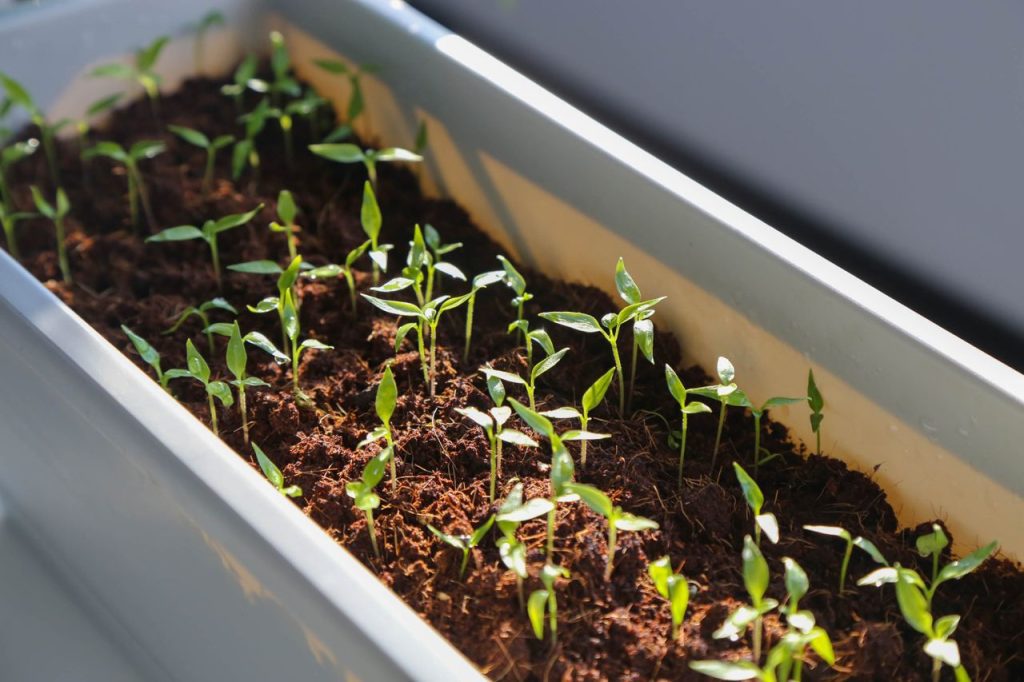
- Seedlings: 24-36 inches
- Vegetative stage: 18-24 inches
- Flowering/fruiting stage: 12-18 inches
Common Grow Light Issues
Once you have your entire setup ready to go, keep an eye on your plants. They will tell you whether you need to make adjustments.
Be on the lookout for any of the following:
- Plants stretching/leaning (Legginess): Light is too far or intensity is too low.
- Bleached, yellowed, or curling top leaves: Light burn (too close or too intense, even without excessive heat).
- Algae growth on soil: Overwatering paired with high light exposure on damp medium.
- Slow or stunted growth: Insufficient daily photoperiod (DLI too low).
Final Thoughts
To grow plants indoors, you need the right light setup, and window lighting will only get you so far.
Whether you’re starting out with just one or two plants or want to go all-in with multiple vegetable crops, you can use this guide to build the perfect light setup for your indoor farm.